
#news

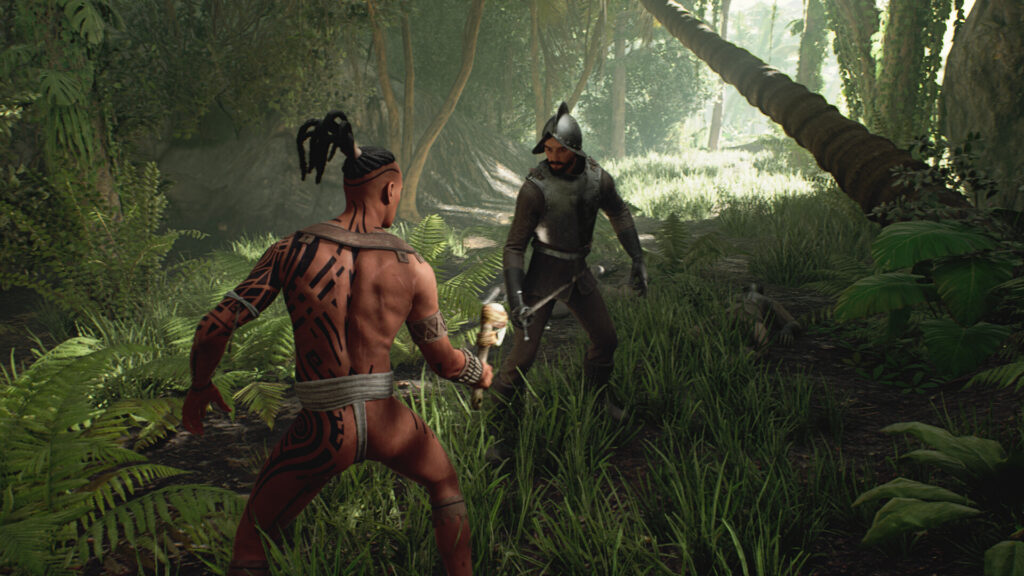
Giantscraft Games, a Polish production company, has launched a video game that invites participants to personify an Aztec warrior in the midst of the Spanish conquest of Tenochtitlan -if you want to know more about this fact you can visit the team’s didactic guide that we link at the end of this article-.
This has awakened multiple positions, not only in Mexico itself, but also in the Spanish society. In Mexico, on the one hand, there are observations about the inaccuracies of the historical characterization of the Aztec groups of that period; on the other hand, there are those who value the creativity of presenting history in a creative way.
In Spain, there is a strong criticism of the reinforcement of the idea of positioning Spain as a “colonizing” power and they react to the fact that users cannot manipulate Spanish warriors. At the same time, there is a resistance to consider that the Spanish conquistadors of that time acted as shown in the video game. There is a group within Spanish society that argues that America was not colonized territory, but were “viceroyalties that were a constituent part of Spain”. This leads to a re-interpretation of the narratives.
In this sense, the reactions to this video game, share the stage with a problem that has been having visibility for some years. In 2016, the International Council of Museums (ICOM) proposed to review the traditional definition of museum. Towards the end of 2022, as a result of extensive debates for years, begins to echo the “decolonization of museums and their narratives.”
What is this?
Decolonizing museums means revising the narratives that circulate in their exhibitions, and incorporating perspectives that are in line with advances in contemporary research. This will mean that each museum will have to review the ways in which the collections were created, their background history, the circulation of the pieces, and those responsible for reception.
In those territories that have had relations of domination with other territories – or war conflicts – many of the objects that are now in their museums have been the result of expropriation, theft, or illegal trafficking. The best known case, for years, was the Napoleon collection taken to the Louvre.
But there are other cases that could imply greater critical awareness. For example, in other cases, certain territories have offered them as “offerings”, but it should be clarified that in the framework of a colonial scenario. Colonialism is not just another stage in the history of some territories, but “a structure that orders and organizes the world” Wolfe (2006).
Returning to the recently launched video game, it can lead us to delve into different aspects of the teaching of history, not only from the problematic of decolonization, but also from the normalization of violent narratives in history.
How does the video game narrative impact on the master narratives of the Spanish past? Is there a need to accept aspects of a colonizing past? What is the place of the normalization of violent narratives? What other ways are there to work on the past from a critical and creative perspective?
IF YOU WANT TO KNOW MORE ABOUT THE FALL OF TENOCHTITLAN, CLICK HERE.
IF YOU WANT TO GO DEEPER INTO STUDIES OF THE NORMALIZATION OF VIOLENCE IN HISTORICAL NARRATIVES WE LEAVE YOU HERE A LINK OF INTEREST.
< VOLVER